
Industrial water managers are under pressure to meet tighter regulations, improve ESG performance, and still control budgets. The real challenge is not picking a technology in isolation, it is understanding industrial water treatment total cost of ownership over 10 to 20 years for options such as RO, UF, MBR, and ZLD.
Capital expenditure is visible on a balance sheet. What quietly erodes value are hidden OPEX, downtime, penalties, and missed reuse opportunities. This guide unpacks those hidden costs and compares the lifecycle economics of the main technologies, with practical examples from industrial users.
1. Why Total Cost of Ownership Matters More Than CAPEX
Most projects still start with a CAPEX comparison. Yet research shows that for advanced water systems, OPEX can exceed initial CAPEX within 4 to 6 years for energy intensive assets.
According to a 2026 analysis from a global water intelligence firm, energy accounts for up to 60% of OPEX in ZLD facilities and around 40 to 60% in industrial RO plants. When electricity tariffs rise or load restrictions appear, that cost profile shifts very quickly.
TCO forces you to look beyond the purchase order toward:
Long term OPEX (energy, chemicals, consumables, labor)
Membrane and equipment replacement
Unplanned downtime and production losses
Compliance penalties and reputational risk
Water reuse savings and resource recovery
A Deloitte 2026 study reports payback periods of 2.6 to 4.2 years for membrane based treatment upgrades in pharma and food sectors, driven largely by water reuse and avoided penalties. In other words, the lowest CAPEX option is often not the best financial decision when viewed through TCO.

Bar chart showing tco per m³ by technology (2026) — data visualization for total cost of ownership per m³ treated (usd)
This first comparison, combining data from several 2026 market studies, shows typical TCO per cubic meter treated :
RO: around 0.80 USD/m³ mid range
UF: around 0.32 USD/m³
MBR: around 1.10 USD/m³
ZLD: around 3.20 USD/m³
UF looks inexpensive. ZLD appears very costly. Yet the right choice depends on treatment objectives, regulatory context, and how these systems are combined.
2. The TCO Framework: How To Calculate Lifecycle Cost
To evaluate industrial water treatment total cost of ownership consistently, it helps to apply a simple framework. Think of TCO as four main buckets over the project life, typically 10 to 15 years.
2.1 The four bucket TCO model
CAPEX Equipment, civil works, installation, engineering
Instrumentation, automation, digital monitoring
Fixed OPEX Minimum staffing, basic maintenance contracts
Insurance, service retainers
Variable OPEX Energy consumption per m³
Chemicals, membrane cleaning agents, consumables
Sludge handling, brine or concentrate disposal
Risk and value impacts Compliance penalties, fines, shutdown orders
Production interruption costs
Water reuse savings and reduced freshwater intake
Resource recovery (salts, energy, byproducts)
In practice, the last bucket is often the largest driver of ROI but is rarely quantified rigorously.
2.2 A basic TCO calculation approach
A pragmatic approach many industrial customers use:
Define the analysis period : typically 10 or 15 years.
Estimate CAPEX : including contingencies and civil works.
Estimate annual OPEX : using vendor data and independent benchmarks.
Model escalation : energy and chemical cost increases of 3 to 6% per year.
Quantify avoided costs :Reduced freshwater purchase or abstraction fees
Avoided penalties and compliance investments
Lower waste hauling and disposal costs
Discount cash flows to present value, then calculate cost per m³ and payback.
A 2026 Bluefield Research statement summarizes this well: “Comprehensive TCO analysis is critical for future proofing investments in water treatment, especially as energy and compliance costs rapidly outpace initial CAPEX.”

Four-quadrant diagram illustrating the TCO framework buckets: CAPEX, Fixed OPEX, Variable OPEX, and Risk and Value Impacts
2.3 When TCO analysis goes wrong
Three common pitfalls distort TCO comparisons:
Ignoring brine or sludge costs : RO and ZLD systems can create significant concentrate volumes. If disposal routes are limited, this can double effective OPEX.
Underestimating membrane replacement : Stretching membranes beyond design life increases risk of failure, quality issues, and emergency replacements at premium cost.
Excluding production risk : For continuous industrial plants, a single day of unplanned shutdown due to water plant failure can exceed a year of OPEX.
A robust TCO model must include these factors, even if some are estimated with bands rather than exact values.
3. RO and UF: TCO Profile, Use Cases, and Trade offs
Reverse osmosis and ultrafiltration are often evaluated together because they are key building blocks in industrial water treatment system budgeting .
3.1 RO TCO: Efficient but energy sensitive
Large scale industrial RO systems in 2026 have an average TCO of 0.62 to 0.98 USD/m³ according to Bluefield Research, with a mid range of about 0.80 USD/m³ when properly designed and operated. Around 40 to 60% of that is energy , depending on feed quality and recovery targets.
Key RO cost drivers:
Feed TDS and fouling potential
Recovery rate (higher recovery usually means higher energy and cleaning)
Pretreatment quality (UF or multimedia)
Membrane life and cleaning protocol
TCO of industrial RO systems is highly sensitive to energy tariffs and to how consistently the plant is run at design conditions. Poor control can increase OPEX by 20 to 30%.
Where RO excels :
Producing high quality process water
Polishing biologically treated effluent for reuse
Enabling partial water reuse when ZLD is not required
Counterargument : For some medium salinity waters with moderate reuse targets, a robust UF plus biological system may achieve compliance at lower OPEX. RO should not be a default choice without checking the full TCO picture.
3.2 UF TCO: Low OPEX workhorse
Ultrafiltration typically has the lowest OPEX among advanced treatment systems , with an IDTechEx 2026 study putting UF at 0.22 to 0.41 USD/m³ . For many plants, UF is used as:
Pretreatment for RO
Polishing step after biological treatment
UF costs are driven by:
Flux and membrane area
Backwash frequency and air scour energy
Cleaning chemicals
Because UF usually runs at lower pressures than RO, its energy consumption is modest. While it cannot replace RO for high purity applications, UF can significantly improve the total cost of ownership wastewater treatment when used strategically.
3.3 RO vs UF vs MBR vs ZLD in context
A 2026 industry survey notes that 67% of new industrial facilities in Asia deploy hybrid combinations of RO, UF, MBR, and ZLD rather than a single technology. UF is rarely evaluated on its own. Instead, it is seen as a way to protect RO or MBR and extend membrane life, which reduces TCO.
RO: 55% energy , 15% membrane replacement, 20% chemicals, 10% labor and maintenance
MBR: 45% energy , 25% membrane replacement, 18% chemicals, 12% labor and maintenance
ZLD: 60% energy , 8% membrane replacement, 15% chemicals, 17% labor and maintenance
The conclusion is clear: energy efficiency and runtime optimization are primary levers for TCO reduction across membrane based systems.
4. MBR Economics: Is MBR More Expensive Than Conventional Treatment?
A recurring question from engineers and finance teams is: “Is MBR more expensive than conventional activated sludge?” The answer is nuanced and depends heavily on land cost, effluent targets, and reuse goals.
4.1 Typical MBR TCO and drivers
Global Water Intelligence 2026 data suggest industrial membrane bioreactor cost in TCO terms is typically 0.85 to 1.30 USD/m³ , with a central estimate of around 1.10 USD/m³ once energy, membranes, chemicals, and maintenance are included.
MBR TCO drivers include:
Aeration energy (biological and membrane scouring)
Membrane area and flux selection
Sludge handling and disposal
Automation level and operator skill
Membrane replacement is a meaningful component, roughly 20 to 30% of OPEX for many plants. However, digital diagnostics and optimized cleaning are reducing unplanned replacements and extending life.
4.2 MBR vs conventional activated sludge cost profile
From a TCO standpoint, conventional activated sludge often has lower CAPEX but:
Requires larger land footprint
Produces more sludge
Needs secondary clarifiers and often tertiary filtration
Struggles to reliably meet stricter nutrient and BOD limits without add ons
Several 2026 benchmarks show MBR vs conventional activated sludge cost can be comparable or even favorable for:
Sites with high land cost
Strict discharge or reuse quality targets
Plants seeking compact retrofits within existing boundaries
Energy cost of MBR vs conventional treatment is typically higher for MBR, but avoided tertiary treatment, reduced sludge handling, and better effluent quality can compensate in the TCO.
4.3 Case study: Pharma plant MBR + RO upgrade
A leading Indian pharmaceutical manufacturer upgraded from conventional biological treatment plus sand filtration to a modular MBR + RO system delivered by BlueDrop Waters .
Key outcomes (2026):
28% reduction in OPEX for wastewater treatment
Full regulatory compliance for stricter 2026 norms
Water reuse increased, cutting freshwater intake
3.2 year payback period , better than the 4 to 5 years initially expected
Here, the industrial water treatment cost analysis showed that higher initial CAPEX for MBR and RO was offset by:
Smaller footprint compared with expanded conventional tanks
Reduced sludge hauling
Lower chemical consumption for polishing
Avoided non compliance penalties and production risk
This is a good example of TCO outperforming simple CAPEX comparisons.
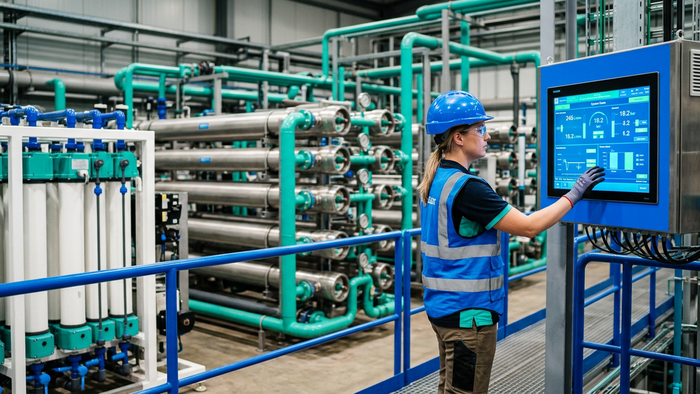
Industrial operator in a clean water treatment facility monitoring MBR membrane racks and digital control panels
5. ZLD Economics: When Do High TCO Systems Make Sense?
Zero Liquid Discharge has a reputation for being expensive, and the data confirms this. However, regulatory forces and water scarcity are changing the ROI equation.
5.1 Typical ZLD TCO and key costs
A 2026 industry assessment reports ZLD TCO of 2.30 to 4.10 USD/m³ for industrial plants, with a mid range of around 3.20 USD/m³. Energy intensive evaporation and crystalization stages dominate OPEX.
GWI 2026 data indicates energy costs in ZLD facilities can reach 60% of total OPEX . Brine management and solid waste disposal add another significant portion.
Major cost elements in TCO of ZLD systems for power plants and other large users:
Thermal energy for evaporators and crystallizers
Scaling control chemicals and anti scalants
Concentrate and salt handling
High grade materials for corrosion resistance
5.2 Why ZLD is still growing
Despite high cost, a 2026 water policy review projects a 22% year on year increase in industrial ZLD project tenders in South Asia once new discharge rules take effect.
A Deloitte water policy specialist noted in 2026 that when comparing ZLD vs RO cost , decision makers must factor in evolving penalty regimes: penalties for non compliance could double the payback value of compliant investments by 2026.
ZLD is most compelling when:
No liquid discharge is legally allowed
Groundwater is highly stressed or protected
Brine disposal options are extremely limited or costly
Recovered water has high value in process or cooling
In these contexts, ROI of ZLD systems comes from avoided closure risks, secure water supply, and enhanced ESG profile.
5.3 Case study: Food processing complex ZLD project
A South Asian food processing complex implemented a ZLD solution with BlueDrop Waters as part of a broader sustainability program.
By mid 2026 the plant had achieved:
92% water recovery , sharply reducing freshwater intake
39% reduction in brine disposal costs due to optimized brine concentration and crystallizer operation
Measurable improvement in ESG scores, attractive to export customers and investors
While the zero liquid discharge cost per cubic meter remained higher than alternative partial reuse options, the client’s board considered it justified in light of tightening local regulations and reputational benefits.

Line chart showing compliance penalty exposure index rising from 100 in 2025 to 220 in 2026 for industrial water dischargers
A simple line comparison of compliance related costs from Deloitte 2026 shows average compliance penalty exposure increasing from 100% in 2025 to 220% in 2026 for non compliant dischargers under new regimes. This shift materially improves the business case for ZLD and high performance reuse systems.
5.4 Counterargument: When ZLD may be excessive
There are cases where full ZLD is not economically optimal:
Locations with stable, affordable brine disposal options
Moderate regulations that allow high quality discharge
Industries with low water scarcity and low social risk
In such situations, a ZLD vs RO cost comparison often favors high recovery RO plus selective brine management as a more balanced solution.
6. Practical Cost Comparisons: RO vs MBR vs UF vs ZLD
To compare options more systematically, industrial managers often ask:
What is the industrial wastewater treatment cost for my flow and contaminant profile?
How does RO vs MBR operating cost compare?
What is the expected payback period for water reuse ?
6.1 RO vs MBR operating cost
RO and MBR serve different functions, but both are membrane based and energy sensitive.
Broadly:
MBR typically has higher OPEX per m³ than tertiary clarification and filtration, but it produces a much higher quality effluent suitable for reuse and RO polishing.
When used together, the RO vs MBR cost balance becomes less about which is cheaper and more about optimizing where energy is spent: in biological aeration, membrane scouring, or RO pressure.
A rule of thumb many practitioners use:
If discharge only is needed, check if enhanced conventional treatment can meet norms at lower TCO.
If high reuse or ZLD is in scope, MBR provides superior and stable feed for RO, which reduces RO OPEX and membrane replacement.
6.2 Cost per m³ comparison by configuration
For a hypothetical 5,000 m³ per day industrial plant in 2026, using market benchmark ranges:
Conventional biological + sand filtration : 0.35 to 0.55 USD/m³
MBR (for reuse quality) : 0.85 to 1.30 USD/m³
MBR + RO reuse : 1.40 to 2.10 USD/m³
MBR + RO + ZLD : 3.0 to 4.5 USD/m³
On the other side of the ledger, the same plant might save:
0.40 to 0.80 USD/m³ by avoiding freshwater purchase or abstraction fees
Additional value by avoiding penalties or production curtailment
This explains why water reuse TCO for chemicals industry and similar sectors often shows attractive payback despite higher per m³ treatment cost.
6.3 How to use these benchmarks
Use TCO benchmarks as starting points, not as final answers. For project teams, useful questions include:
What is my cost per m³ treated water RO UF MBR ZLD in each configuration?
How sensitive are results to energy price changes of ±20%?
What is the TCO impact if reuse targets increase from 60% to 85%?
This sensitivity thinking avoids surprises later, especially if your region is planning tariff changes or stricter discharge norms.
7. How BlueDrop Waters Optimizes TCO Across RO, UF, MBR, and ZLD
BlueDrop Waters works with industrial clients that care about compliance and cost discipline in equal measure. The company’s approach is explicitly built around industrial water treatment total cost of ownership , not just equipment supply.
7.1 Modular, technology agnostic design
Because BlueDrop Waters is technology agnostic, design teams can combine:
RO for high purity and reuse
UF for pretreatment and polishing
MBR for compact, high quality biological treatment
ZLD blocks for strict discharge or water scarce sites
Nature based solutions like aerated constructed wetlands where footprint permits
This full stack portfolio enables hybrid architectures tuned to minimum TCO for each site rather than forcing a single technology.
7.2 Data driven diagnostics and OPEX control
Across more than 1,400 projects, BlueDrop Waters has refined a workflow that uses:
Rigorous upfront water audits and net zero & water investigations
Digital monitoring of flow, energy, and key performance indicators
Transparent reporting on membrane fouling, cleaning efficiency, and downtime
A 2026 market trend study found that digital monitoring and AI based diagnostics reduce unscheduled downtime and OPEX by up to 16% in membrane systems. BlueDrop Waters integrates these tools so that plant managers can track TCO in near real time and justify continuous optimization measures.
7.3 TCO focused case design
For each new project, BlueDrop Waters typically develops two to three configurations with:
CAPEX and OPEX breakdowns
TCO per m³ over a defined horizon
Sensitivity scenarios for energy and chemical price changes
For example, a power plant evaluating TCO of ZLD systems for power plants might compare:
High recovery RO plus brine concentration and partial ZLD
Full ZLD with staged evaporation
Hybrid nature based polishing plus high recovery RO
The design team then co evaluates not only cost but also risk and ESG outcomes with the client, including:
Emissions intensity and treatment plant emissions optimization options
Resource recovery (salts, heat, potential biogas)
Alignment with corporate net zero goals
7.4 Nature based and low energy options
Where land and permitting allow, BlueDrop Waters also deploys aerated constructed wetlands and other ecological systems. These can be particularly attractive for non point source wastewater or as post treatment polishing steps.
Benefits often include:
Lower energy use compared with purely mechanical systems
Enhanced biodiversity and community acceptance
Strong ESG story for sustainability reporting
These alternatives may not replace RO, MBR, or ZLD for high intensity industrial effluents but can reduce load on mechanical systems and thereby reduce TCO.

Flat isometric illustration of a hybrid industrial water treatment plant with labeled RO, UF, MBR, ZLD, and wetland modules connected by flow arrows
8. Step by Step: How To Build a TCO Based Business Case
For water managers preparing a budget or a board paper, a structured process makes decisions more defendable.
8.1 Step 1: Clarify objectives and constraints
Start with non negotiables:
Discharge regulations now and in the next 10 years
Water reuse targets and ESG commitments
Available footprint and expansion potential
Constraints on brine or sludge disposal
This step prevents false comparisons between technology options that cannot actually meet future needs.
8.2 Step 2: Develop 2 to 3 technical scenarios
With your engineering partners, define at least two options, for example:
MBR + RO reuse with 70% reuse
Conventional biological + tertiary treatment with discharge only
MBR + RO + partial ZLD with 90% reuse
Each scenario should include preliminary flow diagrams and performance assumptions.
8.3 Step 3: Build a TCO model
For each scenario, estimate:
CAPEX: equipment, installation, engineering
OPEX by category: energy, chemicals, consumables, labor, disposal
Membrane replacement schedule
Expected downtime and maintenance intervals
Then, factor in:
Avoided freshwater purchase
Avoided penalties or compliance investments
Potential resource recovery
Aim for a water treatment system budgeting model that reports:
Total TCO over 10 to 15 years
Cost per m³ for each scenario
Payback period versus business as usual

Team of engineers and sustainability leaders collaborating over industrial water treatment schematics and plans spread on a conference table
8.4 Step 4: Run sensitivity and risk analysis
Next, test how robust your conclusions are:
What if energy prices increase 10% faster than expected?
What if regulators tighten norms and discharge only is no longer allowed?
What if production expands by 25% in 5 years?
This is where compliance driven water treatment investments often show their strength. Systems that look marginal on a simple base case often become clearly favorable when realistic regulatory and growth scenarios are included.
8.5 Step 5: Convert TCO to a concise narrative
Finally, translate model outputs into a decision ready narrative for executives:
Highlight three key TCO drivers for each scenario
Emphasize non financial risks and ESG implications
Present a clear recommendation and expected payback
Many successful proposals use a simple analogy: treating your water plant like a long term production asset rather than a one time compliance cost. Viewed this way, investing in higher efficiency and reliability is an obvious choice.
9. Three Actionable Takeaways for Industrial Decision Makers
To make this concrete, here are three actions you can take within the next planning cycle.
9.1 Map your current TCO per m³
Estimate your present industrial wastewater treatment cost by dividing total annual water OPEX (including penalties and disposal) by volume treated.
Even a rough estimate will help you:
Benchmark against peers and market data
Spot obvious inefficiencies, such as high chemical use or frequent membrane replacement
Identify where RO, UF, MBR, or ZLD upgrades may create savings
9.2 Design for modularity and hybridization
Given the trend toward hybrid systems, avoid designs that lock you into one rigid configuration. Modular RO, UF, and MBR blocks from providers like BlueDrop Waters can be scaled and reconfigured as regulations or production patterns change.
This approach improves the lifecycle cost of water treatment systems , because you can add or adapt treatment trains without scrapping existing assets.
9.3 Include compliance and ESG in payback calculations
When estimating the payback period for water reuse , factor in:
Avoided penalties and legal risk
Protection against future tightening of discharge limits
Contribution to ESG and net zero targets, which increasingly affects capital cost and investor interest
A Frost & Sullivan 2026 survey found 54% of plants targeting at least 75% reuse for exactly these reasons. Ignoring these factors underestimates the strategic value of advanced treatment upgrades.
10. Frequently Asked Questions
10.1 What is the total cost of ownership of an RO system?
For large scale industrial plants, TCO of industrial RO systems typically ranges from 0.62 to 0.98 USD/m³ in 2026 studies, with energy accounting for 40 to 60% of OPEX.
Your specific TCO will depend on feed water quality, recovery rate, pretreatment, energy tariffs, and how effectively the system is monitored and maintained.
10.2 Is MBR more expensive than conventional wastewater treatment?
On a pure OPEX basis, membrane bioreactor cost per m³ is usually higher than conventional activated sludge due to additional membrane related energy and replacement costs.
However, when you include land savings, better effluent quality, reduced sludge, and reuse potential, MBR vs conventional activated sludge cost can be comparable or even favorable, especially in land constrained or high reuse applications.
10.3 How much does a ZLD system cost for an industrial plant?
Typical zero liquid discharge cost in TCO terms ranges from 2.30 to 4.10 USD/m³ treated according to 2026 industrial benchmarks. Energy is the dominant cost component, often up to 60% of OPEX.
Costs vary widely by industry, brine characteristics, and recovery targets. Hybrid designs and process integration can significantly reduce TCO compared with legacy ZLD approaches.
10.4 RO vs MBR: which has lower operating cost?
RO and MBR serve different roles, so direct comparisons should be made carefully. Generally, RO OPEX per m³ is often lower than MBR OPEX per m³ for similar quality water, but RO usually processes a biologically treated and clarified stream.
The real comparison is between different process water treatment comparative cost configurations, such as conventional biology plus RO versus MBR plus RO, where footprint, effluent quality, and reuse objectives all influence total cost.
10.5 How do I calculate TCO for industrial water treatment systems?
To calculate TCO in industrial water applications :
Define the analysis period (10 to 15 years).
Sum CAPEX for equipment, civil works, and installation.
Estimate annual OPEX by category: energy, chemicals, membranes, labor, disposal.
Include avoided costs: freshwater, penalties, production risk, resource recovery.
Discount cash flows to present value and divide by cumulative volume to get a cost per m³.
Many customers work with partners like BlueDrop Waters to structure these models and validate assumptions.
10.6 What factors affect the lifecycle cost of RO, UF, and MBR systems?
Key factors affecting lifecycle cost of water treatment systems using RO, UF, and MBR include:
Feed water quality and variability
Required treated water quality and reuse targets
Energy prices and availability
Membrane fouling tendency and cleaning strategy
Operator competence and digital monitoring practices
Design decisions at the concept stage, such as over sizing or under sizing membranes and blowers, can have a larger impact on TCO than many operators realize.
11. How This Shapes Your Next Investment Decision
The core message is simple: industrial water treatment total cost of ownership is the only honest way to compare RO, UF, MBR, and ZLD.
Market data from 2026 confirms that:
RO and UF offer relatively low TCO for quality improvement and reuse.
MBR brings higher OPEX but delivers compact, high quality treatment with strong reuse potential.
ZLD is expensive per m³ but can be justified by regulations, water scarcity, and strategic ESG goals.
BlueDrop Waters supports industrial and municipal customers in building TCO centered, future ready water infrastructure, using modular and technology agnostic solutions backed by data and transparent reporting.
If you are planning an upgrade or a greenfield plant, now is the time to move beyond CAPEX and build a TCO based roadmap.
Call to action : Visit the BlueDrop Waters website or contact the team to request a tailored industrial water treatment cost analysis and TCO comparison for your facility.